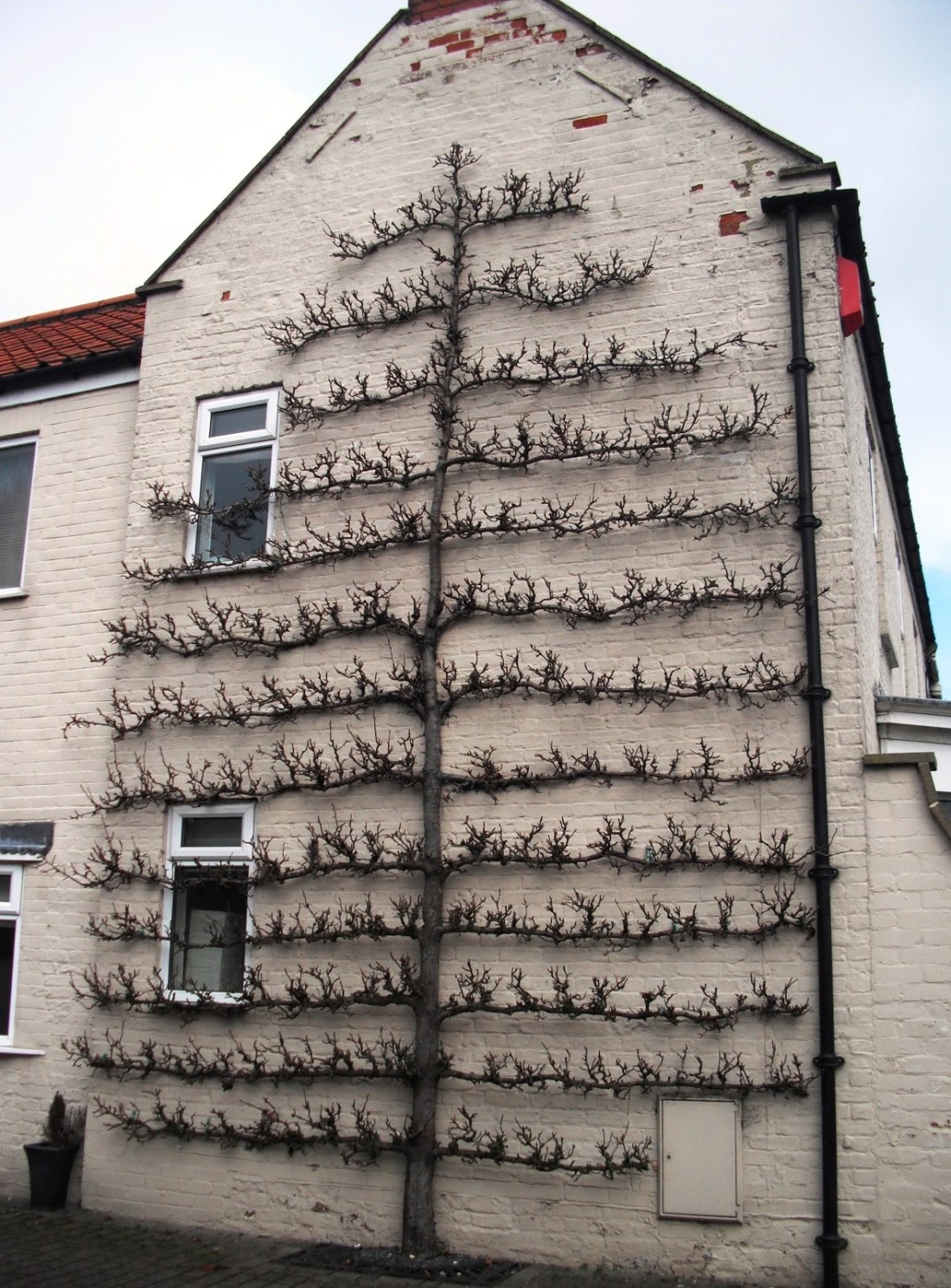
An espaliered fruit tree. Espalier is the horticultural and ancient agricultural
practice of controlling woody plant growth for the production of fruit,
by pruning and tying branches to a frame, frequently in formal
patterns, flat against a structure such as a wall, fence, or trellis,
and also plants which have been shaped in this way.
When I was in state prison in Georgia in 2013, I heard about a class called “Motivation for Change.” I think it had to do with changing your mindset. I’m not actually sure, though, because I was never able to take it. On the first day, the classroom was full, and the teacher was asking everybody’s name. When my turn came, I had to write my name on a piece of paper and give it to a guy to speak it for me. The teacher wrote me a message on a piece of paper: “Are you deaf?”
“Yes, I’m deaf,” I said.
Then she told me to leave the room. I waited outside for a few minutes, and the teacher came out and said, “Sorry, the class is not open to deaf individuals. Go back to the dorm.”
I was infuriated. I asked several other deaf guys in the prison about it, and they said the same thing happened to them. From that point forward, I started filing grievances. They kept denying them, of course. Every other class—the basic computer class, vocational training, a reentry program—I would get there, they would realize I was deaf, and they would kick me out. It felt like every time I asked for a service, they were like, fuck you, no you can’t have that. I was just asking for basic needs; I didn’t have a way to communicate. And they basically just flipped me the bird.
While I was in prison they had no American Sign Language (ASL) interpreters. None of the staff knew sign language, not the doctors or the nurses, the mental health department, the administration, the chaplain, the mail room. Nobody. In the barbershop, in the chow hall, I couldn’t communicate with the other inmates. When I was assaulted, I couldn’t use the phone to call the Prison Rape Elimination Act (a federal law meant to prevent sexual assault in prison) hotline to report what happened. And when they finally sent an interviewer, there was no interpreter. Pretty much everywhere I went, there was no access to ASL. Really, it was deprivation.
I met several other deaf people while I was incarcerated. But we were all in separate dorms. I would have liked to meet with them and sign and catch up. But I was isolated. They housed us sometimes with blind folks, which for me made communication impossible. They couldn’t see my signs or gestures, and I couldn’t hear them. They finally celled me with another deaf inmate for about a year. It was pretty great, to be able to communicate with someone. But then he got released, and they put me with another blind person.
When I met with the prison doctor, I explained that I needed a sign language interpreter during the appointment. They told me no, we’d have to write back and forth. The doctor asked me to read his lips. But when I encounter a new person, I can’t really read their lips. And I don’t have a high literacy level, so it’s pretty difficult for me to write in English. I mean, my language is ASL. That’s how I communicate on a daily basis. Because I had no way to explain what was going on, I stopped going to the doctor.
My health got worse. I came to find out later that I had cancer. When I went to the hospital to have it removed, the doctor did bring an interpreter and they explained everything in sign language. I didn’t understand, why couldn’t the prison have done that in the first place? When I got back to prison, I had a lot of questions about the medicines I was supposed to take. But I couldn’t ask anyone.
I did request mental health services. A counselor named Julie was very nice and tried her best to tell the warden I needed a sign language interpreter. The warden said no. They wanted to use one of the hearing inmates in the facility who used to be an interpreter because he grew up in a home with deaf parents. But Julie felt that was inappropriate, because of privacy concerns. Sometimes, we would try to use Video Remote Interpreting, but the screen often froze. So I was usually stuck having to write my feelings down on paper. I didn’t have time to process my emotions. I just couldn’t get it across. Writing all that down takes an exorbitant amount of time: I’d be in there for 30 minutes, and I didn’t have the time to write everything I wanted to. Julie wound up learning some sign language. But it just wasn’t enough.
My communication problems in prison caused a lot of issues with guards, too. One time, I was sleeping, and I didn’t see it was time to go to chow. I went to the guard and said, “Hey man, you never told me it was chow time.” I was writing back and forth to the guard, and he said he can’t write because it’s considered personal communication, and it was against prison policy for guards to have a personal relationship with inmates. That happened several times. I would have to be careful writing notes to officers, too, because it looked to the hearing inmates like I was snitching.
Once they brought me to disciplinary court, but they had me in shackles behind my back, so I had no way to communicate.Two of the corrections officers in the room were speaking to me. All I saw were lips moving. I saw laughter. One of the guards was actually a pretty nice guy, one of the ones who was willing to write things down for us deaf folks. He tried to get them to take the cuffs off me. He wrote, guilty or not guilty? But the others would not uncuff me. I wanted to write not guilty. I wanted to ask for an interpreter. But I couldn’t. They said, “OK, you have nothing to say? Guilty.” That infuriated me. I started to scream. That was really all that I could do. They sent me to the hole, and I cried endlessly. It’s hard to describe the fury and anger.
Prison is a dangerous place for everyone, but that’s especially true for deaf folks.
Jeremy Woody, 48, was released from Central State Prison in Georgia in August 2017, after serving four years for a probation violation. He now lives near Atlanta. He is currently suing Georgia corrections officials over his treatment in prison, with the help of the American Civil Liberties Union’s Disability Rights Program and the ACLU of Georgia. Woody spoke to The Marshall Project through an American Sign Language interpreter.
The Georgia Department of Corrections did not respond to a request for comment concerning allegations in this interview.
Cannot recommend WDHDT highly enough. I’ve found it helpful not just for romantic relationships, but also for growing up w a “unexplainable/uncontrollable” dad.
IT HAS ALSO BEEN REALLY HELPFUL FOR UNDERSTANDING ONLINE MOB HARASSMENT.
So if you’ve ever been bombarded w threats to be raped/killed, (so…if you’re a minority and you’ve been on the Internet for a while), this book might be useful for getting clarity around the whole entitled, abusive mindset that drives certain kinds of people to behave that way. And by “getting clarity”, I mean (for me) being able to go “oh, that’s what’s happening” and not really feel scared anymore. Or angry, or drawn out into it, or anything.
And if you’re still standing around going “but how does something like GamerGate happen?” or “but why do men hit their wives?” or whatever – please read that book and learn something.
^^^^ truth WDHDT is fantastic at cutting down MRA bullshit and calling it what it really is
Please consider reading these. WDHDT is really, really helpful. And I know some of you are struggling with abusive relationships, friendships, families, etc. You’re not alone. There is help.
Yo. This family holiday, please, please take care of yourself. You aren’t there to be anybody else’s cushion.
Adult Children of Emotionally Immature Parents: How to Heal from Distant, Rejecting, or Self-Involved Parents
Reading any of these books does not mean you don’t love your parents or family. It’s just self care for helping you cope and not repeat the behaviors.
like the complete dissociation from the body and constant societal and interpersonal gaslighting from men and the inherent abuse of living under patriarchy like it literally all just makes it so that women are permanently placed within a position where were all convinced that we are half a step away from full blown insanity and are barely concealing it but thats not an individual experience its collective like im just WOW women are crazy bc theres no way to function wo men viewing u as such and theres no way to cope w the warped and fucked up realities of patriarchy wo going insane
“Almost every woman I have ever met has a secret belief that she is just on the edge of madness, that there is some deep, crazy part within her, that she must be on guard constantly against ‘losing control’ — of her temper, of her appetite, of her sexuality, of her feelings, of her ambition, of her secret fantasies, of her mind.”
— Elana Dykewomon, “Notes for a Magazine,” Sinister Wisdom #36 (Winter 1988/89)
Except no that’s not what happened, that’s not why he sued, he sued because when he went to ask for more napkins, the staff started racially harassing him, all over fucking napkins. As for the amount, ut was probably exaggerated by the lawyer so when the court shrinks it, McDonalds would still have to pay at least something.
There are no such things as frivolous lawsuits made by individual people.
McDonald’s (and most businesses) have insanely good pr departments. The woman who sued McDonald’s for being burned by their coffee was turned into the face of “people will sue over anything” because suing over coffee being hot sounds ridiculous, right? Except for she was literally burned to the bone. The pictures are nauseating. What she went through was horrifying.
If you ever find yourself ridiculing an individual on a company’s behalf you’re probably just repeating pr propaganda






 queerlybeloveds