An excellent article in the Sydney Morning Herald today about #MeToo and why romance authors need to pay attention. Sadly, I missed it, but many attendees at the RWAus conference this year told me Kate Cuthbert’s keynote speech was INCREDIBLE.
“But Cuthbert is talking about more than just entertainment. In her
speech she nails the powerful element of romance writing that has made
it such a huge and perennial phenomenon: the hope it offers for women’s
lives to be well-lived.”
*air punch*
Incidentally, for those who might not know who Kate Cuthbert is, she’s FUCKING AWESOME. She’s the managing editor at Escape Publishing, a digital-first imprint owned by Harlequin/Mills and Boon here in Australia. Escape give a LOT of people rejected from the main HQN lines a place to publish. I pitched to her last year at the RWAus conference (my first ever pitch!) and she was SO NICE. That book is currently on submission to a main HQN line but if it doesn’t get in, Kate is my next port of call.
She has her finger absolutely on the pulse of what readers want and enjoy, possibly more so than any other mainstream romance publisher at any given moment because Escape are much faster to publishing than most trads. Kate KNOWS. Listen to her, people.
“It won’t be easy, Cuthbert adds. ‘But the alternative is to continue
normalising coercion and domination and disrespect and powerlessness in
our romantic relationships.’
She’s right about it not being easy.
The alpha male of traditional romantic fiction teeters right on the
brink of toxicity: it’s a short step from gorgeous bad boy to
domineering brute, and much of the appeal lies in flirting with danger.”
One good reason for writers to give particularly careful consideration to what type of heroine is partnered with an alpha hero.Almost invariably, the answer seems to be a heroine who is herself alpha. She won’t be browbeaten, she is decisive, knows how to take care of herself, and takes the lead and goes for what she wants without apologies.If you want the adrenaline rush of “flirting with danger”, then make the heroinea proactive, capable protagonist, not a subject.
The amount of times I could have been that white girl in the horror movie could honestly be a movie in itself and it’s honestly a waste that my entire life isn’t constantly recorded on film because it would be HILARIOUS
1. That one time I decided to see what was past the old gate in the woods, but when got there it had been smashed in half and there was a decapitated sheep head with no skin just off the trail, so instead I just turned around and went home.
2. That time some friends and I went camping and we found a pile of bones wrapped in a garbage bag buried under a log, but the adult supervisor told us it was nothing, so we just put it back and didn’t talk about it again.
3. The time I was getting chased through the woods at night and I realized “wait it’s dark as fuck” so I just held still until the guy gave up and left.
4. The time this dude said he was in love with me and so he was going to cut my head off and dump my body in a lake, so I told him to grow the hell up, but then he got caught stealing girl’s underwear a day later and I never saw him again
5. That one time in college where I was taking a shortcut on my home at night and a car followed me into a dark alley, so I stared directly into the driver’s side of the window and walked towards it to psych them out
6. The night I was out on a walk and this old guy told me he’d locked his keys in his truck and that he needed someone my size to crawl in through the back window for him, so I told him “you know that sounds super suspicious right” and told him where to find a pay phone for a tow truck instead
7. The one time this random guy on the street said he was in love with me and so he was going to follow me home on my bus, so I clapped him on the shoulder and told him that if he got that close to my bus then I was going to throw him under the wheels, but then this really nice homeless man from Nigeria told the guy to fuck off and then checked to make sure he didn’t follow me onboard
8. That big cat with yellow eyes who I found in a well and brought home who used to put rotting meat in my closet and wake me up by chewing on my face, until I put him back outside and never saw him again.
9. My one cousin who used to come over for the summer who kept calling me ‘piñata’ and hitting me with sticks, until he went back home and was sent to juvie cause he finally got caught torturing animals
10. The time I got lost on the way to a meeting and wound up at a circus tent instead, and got followed by a full-out clown for three vacant street blocks
11. The pet hamster I had when I was seven who would scream all night and eventually escaped by ripping a bar out of its cage and wiggling through the hole. My mom caught it and put it back but it lived another year and a half until one night the screaming just stopped
12. The time I was whistling in the woods and something started whistling back, so I went home
13. That one night at summer camp where a group of girls got together to play ‘bloody mary’ in the lavatory and invited me to come with them so I said “no thanks” and stayed with the camp councillors and drank soup instead.
14. The old abandoned house I just moved into with the door that leads into a big empty room full of dirt and empty cooking pots that I just sort of… locked up forever and never go near
15. Once when I was at an ihop I saw a coffee mug do a full 360º spin with nobody touching it, so I said ‘that was neat’ and never ate there again
16. The time I took a photo of a big old raven sitting on the crucifix on top of the old town church cause it was the most goth thing I’d ever seen, right? But then it swooped down towards me, so I apologized immediately for being rude, and I felt a little silly for a while but the car that hit me on the way home didn’t even leave a bruise so idk be nice to birds
It’s hard to describe to non-creators how difficult it is to be abstract when you’re in pain, or when you’re exhausted, or when illness or drugs or mental illness has washed you up on a strange chemical shore. All art requires an element of abstraction, of big picture thinking, because art at its heart is simply the act of imposing artificial structure upon the world. With writing, you don’t even have the concrete sensory anchor of paint or clay or bricks. You have only words, in themselves already art, some past human’s clumsy attempt to translate a concept to a vocalization.
When you’re an animal under duress, the big picture feels very unimportant.
I’ve talked a little bit about my health struggles over the past 18 or so months, the implosion of my immune system, the shrinking diet, the fatigue, the failure of my adrenals, the discovery that hookworms were living in my fucking face. It was all pretty impossible. The part that made it the most impossible? The brain fog. Brain fog’s pretty common with all sorts of inflammation, and before I figured out that a huge part of my problem was that I had face-friends, I was pretty much always locked in brain fog. Some days it was just confusion. Light inability to finish sentences predicted from 3-6 pm, bring an umbrella. Other days, I couldn’t remember my home address.
The problem was I had a book due. So I threw myself against it, because that’s how I had always approached life. Screw you, brain fog, illness, allergic reaction, I’m just going to push through.
I would get up every morning and begin working on ALL THE CROOKED SAINTS. One labored word after another. I would sit at the computer for 12 hours to accomplish a paragraph. The next day, if the fog had cleared a little, I would ditch all of the repeated words and the sentences that led to nothing. Most days that was everything. Some days I got to keep a few sentences. On good days, I tried to use my brain to solve big picture problems and get enough of it down that my fogged brain the next day wouldn’t mess it up too much. Then I would get up the next day and I would do all this again. 12 hours. 1 paragraph. I would do it again the next day. The next day.
I used to write rough drafts in four months in four hours of writing every other day. With Saints, I wrote for 12 hours a day for an entire year. Quite literally I did nothing else — everything else fell apart and away. I muscled through. If I couldn’t understand words, I sat there and I typed nonsense until I could. I read it aloud until the words sounded familiar. I leaned heavily on every beta reader and critique partner — tell me when I start to make a book, friends, please, tell me when I’ve gotten into the weeds. Finally I managed to turn it in.
People say that book doesn’t sound quite like my others — no, it wouldn’t. I fought wars for that book. They say it sounds more precise, more poetic, more deliberate. Yes, it would. Every word was stolen, snatched, cobbled, carefully assembled. I can reread any of my other books, but not that one. I open it to a random page and I can only remember the weeks it took to accomplish each of them.
I’m telling you all this because I was wrong.
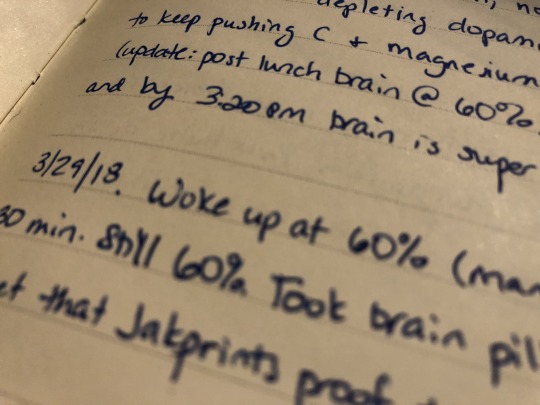
Back in early spring of this year, after I’d gotten the hookworms out of my face but while I was still dealing very intensely with all the physical damage left behind, a very wise woman gave me a piece of advice. She told me to start a journal. In the morning, she said, write down the percentage that I felt I was that day. 20% Maggie. 90% Maggie. Then I should write down what I accomplished that day.
I thought at this point she was going to tell me to admire how much I’d gotten done each day despite being ill. I didn’t want that; I didn’t need a pep talk. I needed my brain.
But that wasn’t what she said. She told me: write down what you’ve managed to do on a 20% day, what you’ve managed to do on a 40% day. Eventually you’ll have a guide so when you wake up and you’re at 20%, you won’t try to do the things you do on a 40% day. You’ll know you can just go watch a movie or sit with your goats or whatever and not feel guilty, because you were never going to write words you could keep or be able to exercise or whatever.
And that was the right way.
It meant I no longer labored for 12 hours each day, doing nothing but trying to smash my way through a draft. Instead I slowly began to write bits and bobs in on my good days. A funny thing happened then: once I was not spending every second forcing myself to do things I couldn’t, I found I had enough energy to actually start to work on myself. To look for patterns in my good and bad days. To research healthcare providers and new studies on what was wrong with me still. Slowly I found I was able to chain more of the 60% days together, then 80% days. Slowly I began to realize that although it was taking months, I was improving overall.
I threw out every labored word I had written on my current book and I began again with ferocious and structured joy. It took me only a few weeks to completely regain the wordcount of that draft I forced, only this book was free and easy and ridiculous and batshit and I loved it.
I still have 20% days. Really, seriously, don’t let hookworms in your face, especially if you already have an underlying condition. I don’t know when I’ll actually be completely better. But I do know that on those 20% days, I don’t have to make things. It’s ok. I can spend those days enjoying whatever I can. Consuming art instead of making it. That’s enough. That’s right.
I’m very proud of Saints, both how it turned out and what it took from me. But I wouldn’t wish that on anyone. There’s a better way.
Good luck,
urs,
Stiefvater
I’ve had serious brain fog all week, and trying to complete my script that’s due tomorrow for work has felt like fighting an undertow when you can’t pull your head above the waves for even a single breath.
Thank you so much for sharing this. It feels so good to know that I’m not alone, and that one of my favorite writers struggles with this too. It doesn’t mean I can’t be a successful writer. I just have to learn to be work with myself instead of against myself.
Thank you thank you thank you, and I hope for more 90%+ days for you soon.
Writing with Color: Description Guide – Words for Skin Tone
We discussed the issues describing People of Color by means of food in Part Iof this guide, which brought rise to even more questions, mostly along the lines of “So, if food’s not an option, what can I use?” Well, I was just getting to that!
This final portion focuses on describing skin tone, with photo and passage examples provided throughout. I hope to cover everything from the use of straight-forward description to the more creatively-inclined, keeping in mind the questions we’ve received on this topic.
So let’s get to it.
S T A N D A R D D E S C R I P T I O N
B a s i c C o l o r s
Pictured above: Black, Brown, Beige, White, Pink.
“She had brown skin.”
This is a perfectly fine description that, while not providing the most detail, works well and will never become cliché.
Describing characters’ skin as simply brown or beige works on its own, though it’s not particularly telling just from the range in brown alone.
C o m p l e x C o l o r s
These are more rarely used words that actually “mean” their color. Some of these have multiple meanings, so you’ll want to look into those to determine what other associations a word might have.
Complex colors work well alone, though often pair well with a basic color in regards to narrowing down shade/tone.
For example: Golden brown,russet brown, tawny beige…
As some of these are on the “rare” side, sliding in a definition of the word within the sentence itself may help readers who are unfamiliar with the term visualize the color without seeking a dictionary.
“He was tall and slim, his skin a russet, reddish-brown.”
Comparisons to familiar colors or visuals are also helpful:
“His skin was an ochre color, much like the mellow-brown light that bathed the forest.”
M o d i f i e r s
Modifiers, often adjectives, make partial changes to a word.The following words are descriptors in reference to skin tone.
D a r k – D e e p – R i c h – C o o l
W a r m – M e d i u m – T a n
F a i r – L i g h t – P a l e
Rich Black, Dark brown, Warm beige, Pale pink…
If you’re looking to get more specific than “brown,” modifiers narrow down shade further.
Keep in mind that these modifiers are not exactly colors.
As an already brown-skinned person, I get tan from a lot of sun and resultingly become a darker,deeper brown. I turn a pale, more yellow-brown in the winter.
While best used in combination with a color, I suppose words like “tan”“fair” and “light” do work alone; just note that tan is less likely to be taken for “naturally tan” and much more likely a tanned White person.
Calling someone “dark” as description on its own is offensive to some and also ambiguous. (See: Describing Skin as Dark)
U n d e r t o n e s
Undertones are the colors beneath the skin, seeing as skin isn’t just one even color but has more subdued tones within the dominating palette.
Mentioning the undertones within a character’s skin is an even more precise way to denote skin tone.
As shown, there’s a difference between say, brown skin withwarm orange-red undertones (Kelly Rowland) and brown skin with cool, jewel undertones (Rutina Wesley).
“A dazzling smile revealed the bronze glow at her cheeks.”
“He always looked as if he’d ran a mile, a constant tinge of pink under his tawny skin.”
Standard Description Passage
“Farah’s skin, always fawn, had burned and freckled under the summer’s sun. Even at the cusp of autumn, an uneven tan clung to her skin like burrs. So unlike the smooth, red-brown ochre of her mother, which the sun had richened to a blessing.”
Here the state of skin also gives insight on character.
Note my use of “fawn” in regards to multiple meaning and association. While fawn is a color, it’s also a small, timid deer, which describes this very traumatized character of mine perfectly.
Though I use standard descriptions of skin tone more in my writing, at the same time I’m no stranger to creative descriptions, and do enjoy the occasional artsy detail of a character.
C R E A T I V E D E S C R I P T I O N
Whether compared to night-cast rivers or day’s first light…I actually enjoy seeing Characters of Colors dressed in artful detail.
I’ve read loads of descriptions in my day of white characters and their “smooth rose-tinged ivory skin”, while the PoC, if there, are reduced to something from a candy bowl or a Starbucks drink, so to actually read of PoC described in lavish detail can be somewhat of a treat.
Still, be mindful when you get creative with your character descriptions. Too many frills can become purple-prose–like, so do what feels right for your writing when and where.
Not every character or scene warrants a creative description, either. Especially if they’re not even a secondary character.
Using a combination of color descriptions from standard to creative is probably a better method than straight creative. But again, do what’s good for your tale.
Now before you run off to compare your heroine’s skin to the harvest moon or a cliff side, think about the associations to your words.
When I think cliff, I think of jagged, perilous, rough. I hear sand and picture grainy, yet smooth. Calm. mellow.
So consider your character and what you see fit to compare them to.
Also consider whose perspective you’re describing them from. Someone describing a person they revere or admire may have a more pleasant, loftier description than someone who can’t stand the person.
“Her face was like the fire-gold glow of dawn, lifting my gaze, drawing me in.”
“She had a sandy complexion, smooth and tawny.”
Even creative descriptions tend to draw help from your standard words.
F L O W E R S
Pictured above: Calla lilies, Western Coneflower, Hazel Fay, Hibiscus, Freesia, Rose
It was a bit difficult to find flowers to my liking that didn’t have a 20 character name or wasn’t called something like “chocolate silk” so these are the finalists.
You’ll definitely want to avoid purple-prose here.
Also be aware of flowers that most might’ve never heard of. Roses are easy, as most know the look and coloring(s) of this plant. But Western coneflowers? Calla lilies? Maybe not so much.
“He entered the cottage in a huff, cheeks a blushing brown like the flowers Nana planted right under my window. Hazel Fay she called them, was it?”
These ones are kinda odd. Perhaps because I’ve never seen these in comparison to skin tone, With the exception of amber.
At least they’re common enough that most may have an idea what you’re talking about at the mention of “pinecone.“
I suggest reading out your sentences aloud to get a better feel of how it’ll sounds.
“Auburn hair swept past pointed ears, set around a face like an acorn both in shape and shade.”
I pictured some tree-dwelling being or person from a fantasy world in this example, which makes the comparison more appropriate.
I don’t suggest using a comparison just “cuz you can” but actually being thoughtful about what you’re comparing your character to and how it applies to your character and/or setting.
W O O D
Pictured above: Mahogany, Walnut, Chestnut, Golden Oak, Ash
Wood can be an iffy description for skin tone. Not only due to several of them having “foody” terminology within their names, but again, associations.
Some people would prefer not to compare/be compared to wood at all, so get opinions, try it aloud, and make sure it’s appropriate to the character if you do use it.
“The old warlock’s skin was a deep shade of mahogany, his stare serious and firm as it held mine.”
These are trickier to use. As with some complex colors, the writer will have to get us to understand what most of these look like.
If you use these, or any more rare description, consider if it actually “fits” the book or scene.
Even if you’re able to get us to picture what “rutile” looks like, why are you using this description as opposed to something else? Have that answer for yourself.
“His skin reminded her of the topaz ring her father wore at his finger, a gleaming stone of brown, mellow facades.”
P H Y S I C A L D E S C R I P T I ON
Physical character description can be more than skin tone.
Show us hair, eyes, noses, mouth, hands…body posture, body shape, skin texture… though not necessarily all of those nor at once.
Describing features also helps indicate race, especially if your character has some traits common within the race they are, such as afro hair to a Black character.
How comprehensive you decide to get is up to you. I wouldn’t overdo it and get specific to every mole and birthmark. Noting defining characteristics is good, though, like slightly spaced front teeth, curls that stay flopping in their face, hands freckled with sunspots…
G E N E R A L T I P S
Indicate Race Early: I suggest indicators of race be made at the earliest convenience within the writing, with more hints threaded throughout here and there.
Get Creative On Your Own: Obviously, I couldn’t cover every proper color or comparison in which has been “approved” to use for your characters’ skin color, so it’s up to you to use discretion when seeking other ways and shades to describe skin tone.
Skin Color May Not Be Enough: Describing skin tone isn’t always enough to indicate someone’s ethnicity. As timeless cases with readers equating brown to “dark white” or something, more indicators of race may be needed.
Describe White characters and PoC Alike: You should describe the race and/or skin tone of your white characters just as you do your Characters of Color. If you don’t, you risk implying that White is the default human being and PoC are the “Other”).
PSA: Don’t use “Colored.” Based on some asks we’ve received using this word, I’d like to say that unless you or your character is a racist grandmama from the 1960s, do not call People of Color “colored” please.
Not Sure Where to Start? You really can’t go wrong using basic colors for your skin descriptions. It’s actually what many people prefer and works best for most writing. Personally, I tend to describe my characters using a combo of basic colors + modifiers, with mentions of undertones at times. I do like to veer into more creative descriptions on occasion.
Want some alternatives to “skin” or “skin color”?Try:Appearance, blend, blush, cast, coloring, complexion, flush, glow, hue, overtone, palette, pigmentation, rinse, shade, sheen, spectrum, tinge, tint, tone, undertone, value, wash.
I tried to be as comprehensive as possible with this guide, but if you have a question regarding describing skin color that hasn’t been answered within part I or II of this guide, or have more questions after reading this post, feel free to ask!


 queerlybeloveds